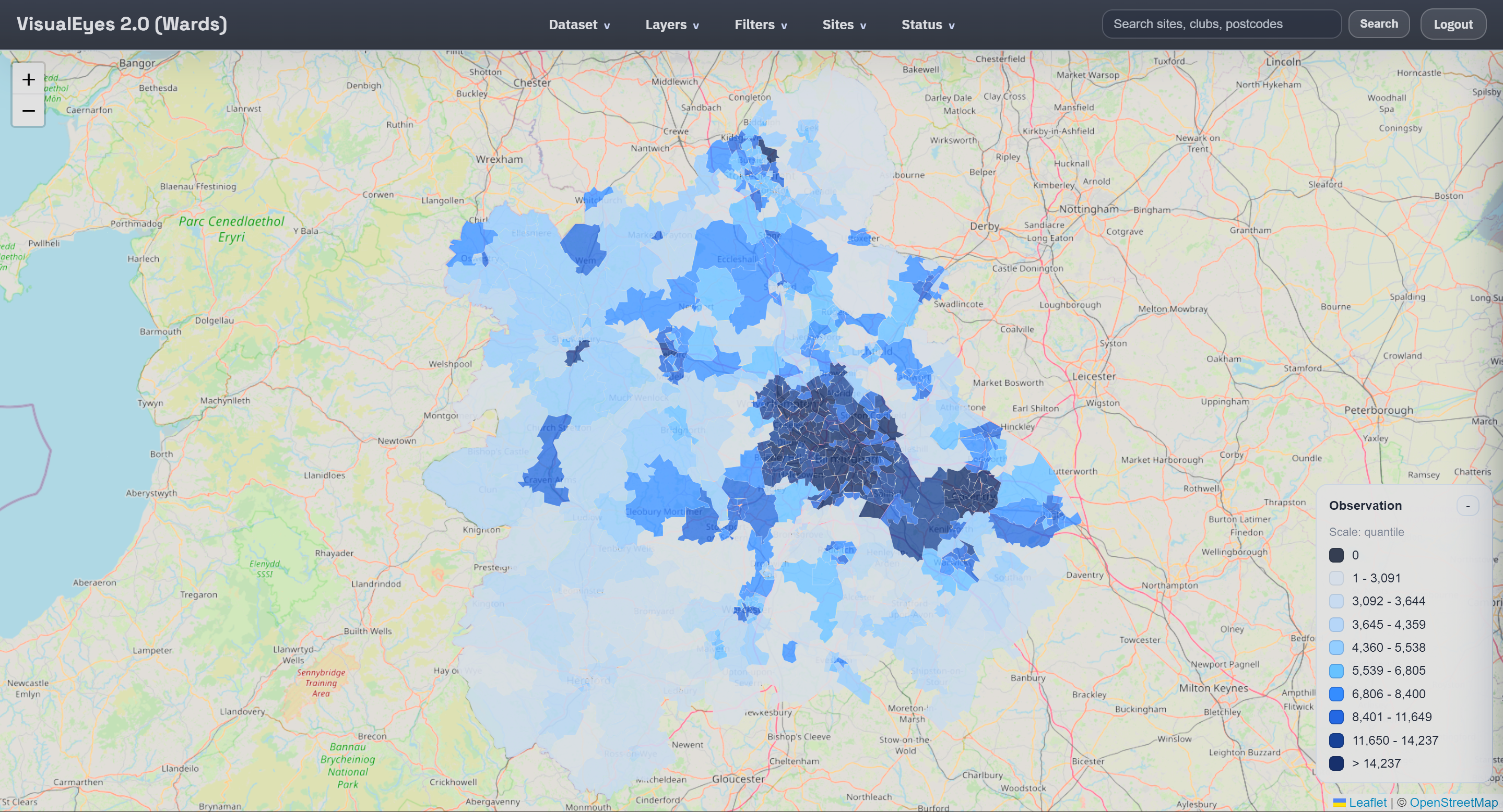
A full-stack GIS solution integrating 10+ distinct datasets—from population demographics to flood risk—to transform how sports organizations allocate funding and identify strategic opportunities.
VisualEyes 2.0 moves beyond simple mapping by creating a unified spatial index of 10+ critical datasets.
Precise filtering on Census data including age, ethnicity, religion, and disability status.
Automatic intersection analysis with Flood Zones (2 & 3), SSSI, SPA, and SAC protected areas.
Visualizing obesity rates, inactivity levels, and health deprivation indices to target funding.
Integration of public transport nodes (Bus, Rail, Tram) to assess site accessibility for non-driving participants.
Mapping existing pitches, faith centers, and healthcare sites to identify service gaps.
Automated generation of PDF data packs for specific sites, ready for grant applications.
Navigating the complexities of disparate spatial data and web performance.
The Problem: Rendering thousands of complex polygons (LSOA/Ward boundaries) in the browser using standard GeoJSON caused significant lag and memory overhead in Leaflet.
The Solution: Implemented a vector tile strategy coupled with geometry simplification on the Flask backend. Used TopoJSON to reduce redundancy in shared borders, cutting payload sizes by ~60% without losing analytical precision.
The Problem: Integrating static Census data with dynamic monthly crime stats and environmental layers, all of which use different spatial keys or projection systems.
The Solution: Built a robust ETL pipeline using Pandas and GeoPandas. Created a unified spatial index based on ONS codes. The pipeline automatically re-projects all incoming layers to EPSG:4326 (WGS84) and handles spatial joins (point-in-polygon) during the data ingestion phase, ensuring instant query times on the frontend.
The Problem: Complex GIS layers were overwhelming for business operational staff who needed simple answers for funding applications.
The Solution: Abstracted the complexity into the "One Click Data Pack". Instead of forcing users to perform spatial queries manually, the backend pre-calculates intersections. The frontend focuses on "Answer First" design—showing the "Feasibility Score" prominently before showing the detailed map layers.
Moving from descriptive maps to predictive intelligence. VisualEyes 2.0 will leverage Spatial-RAG (Retrieval-Augmented Generation) to answer complex strategic questions.
Video Reference: Geospatial Reasoning in Action
Optimizing locations for Comets, SquadGirls, and JustPlay. AI finds the "sweet spot" between target demographics, pitch availability, and lack of existing competition.
Identifying geographic clusters of high Expression of Interest (EoI). Targeted recruitment drives in these hot-spots maximize course attendance and retention.
Generating robust support for planning applications. Automatically collating multi-layer evidence (health, deprivation, demand) to prove the case for new facilities.
Uncovering "blind spots" in the network. Identifying areas with high youth density and demand but zero current provision that manual analysis has overlooked.